


We discussed this in a LinkedIn Live session, "How will VR, AR, Metaverse & Web3 Transform Healthcare?", with Dr Amit Raj, Senior Cardiologist and Managing Director at Plexus Med Care. The session covered both the long-term benefits and the uses that hospitals have already put in place.
The problems immersive technology addresses
Doctors need to understand complex 3D problems inside the body and explain them to patients who cannot see them. Specialists cannot always travel to where they are needed. And trainees need realistic practice, often in high-pressure emergencies, without putting patients at risk. Textbooks and 2D diagrams only go so far, particularly in subjects such as anatomy.
Four ways it is being used
Holographic patient consultation
Doctors can review a patient's condition in 3D, which supports an accurate diagnosis and saves time and money. It helps surgeons plan their way through a surgery, and patients understand their problem more easily because they can see it.
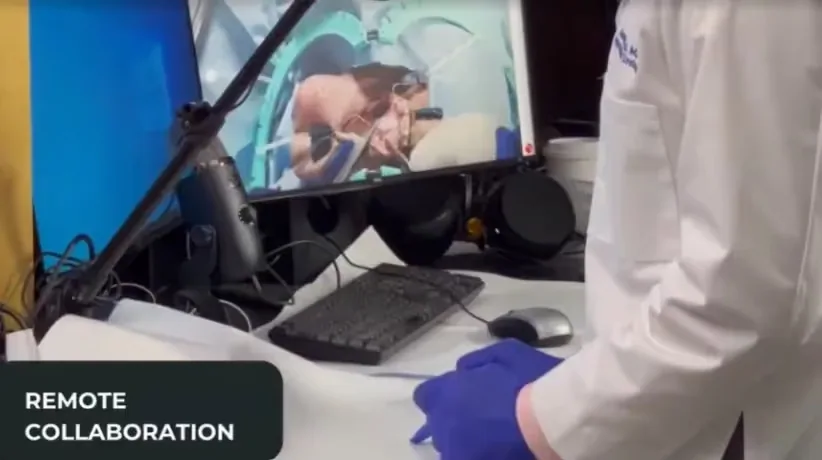
Remote collaboration
When travelling to diagnose is difficult, AR, VR and mixed reality let a doctor be present remotely and guide trainees. With "see what I see" technology, learning becomes easier and trainees feel less cognitive pressure, which improves their performance.
Nurse training in a virtual environment
Nurse trainees follow the same procedures and structure they would in a real ward, but they can do it remotely. They interact with avatars and equipment, check exposure levels and click on a doctor's avatar for guidance. At the end, each trainee sees a report on how well they performed.
3D training simulations
Holograms can explain complex concepts, diagrams and organ functions far more clearly than a flat page. Anatomy is the obvious example, because the human body is hard to understand in two dimensions, but the same approach works for chemistry and physics.
The benefits
- Better insight: doctors and practitioners are connected with the data that matters most.
- Better training: students can perfect their skills in VR without outside pressure.
- Better care: mixed reality supports diagnosis and encourages fewer incisions.
Hospitals already using it
- Apollo Hospitals, one of India's largest healthcare providers, launched Ask Apollo AR, a mobile app that offers virtual consultations with doctors and an AR anatomy module for medical students.
- Narayana Health, a multi-speciality hospital chain in India, partnered with Microsoft to use HoloLens for medical training. Students can view and interact with 3D models of human anatomy.
- Fortis Healthcare uses VR for patient education, with modules that explain medical conditions and treatments, and for physical therapy and rehabilitation.
- Cedars-Sinai Medical Center in Los Angeles uses a VR programme to train nursing staff in patient care scenarios.
- Children's Hospital Los Angeles uses immersive emergency simulations for paediatric treatment. The learner acts as team lead and directs avatar team members, which builds communication and leadership skills under stress.
- Sentinel University of Nursing & Health Sciences in the US created the immersive environments Sentinel City and Sentinel Town, where clinical emergency simulations help nurses practise critical thinking and leadership.
How to apply it
Hospitals and medical device and pharma companies can start where the gap between training and reality is widest: emergency procedures, anatomy teaching or explaining a treatment to patients. A focused VR module or 3D hologram for one of these is a practical first project, and its results make the case for the next.
Next step
If you are planning VR training, 3D medical content or patient education for a hospital or healthcare business, talk to our team. You can also try our VR solutions at the Experience Centre in Noida.
First published on the Metaverse911 blog.
Frequently asked questions
How are VR, AR and holograms used in healthcare?
VR, AR and holograms are used in healthcare for holographic patient consultations, remote collaboration between doctors and trainees, nurse training in virtual environments and 3D training simulations. They help doctors review conditions in 3D and plan surgeries, let patients see and understand their problem, and give trainees realistic practice, including in high-pressure emergencies, without putting patients at risk.
How does holographic patient consultation work?
In a holographic patient consultation, doctors review a patient's condition in 3D, which supports an accurate diagnosis and saves time and money. It helps surgeons plan their way through a surgery, and patients understand their medical problem more easily because they can see it rather than relying on a flat 2D diagram or a verbal description.
How does VR nurse training work?
In VR nurse training, trainees follow the same procedures and structure they would in a real ward, but they can do it remotely. They interact with avatars and equipment, check exposure levels and click on a doctor's avatar for guidance. At the end of the session, each nurse trainee sees a report showing how well they performed.
Which hospitals in India use VR and AR?
Several Indian hospitals use VR and AR. Apollo Hospitals launched Ask Apollo AR, an app offering virtual consultations and an AR anatomy module for medical students. Narayana Health partnered with Microsoft to use HoloLens for medical training with 3D anatomy models. Fortis Healthcare uses VR for patient education and for physical therapy and rehabilitation.
Where should a hospital start with immersive technology?
A hospital should start with immersive technology where the gap between training and reality is widest, such as emergency procedures, anatomy teaching or explaining a treatment to patients. A focused VR module or 3D hologram for one of these is a practical first project, and its results make the case for the next. Metaverse911 VR solutions can be tried at its Experience Centre in Noida.
More from the blog
 Blog · Healthcare & pharma
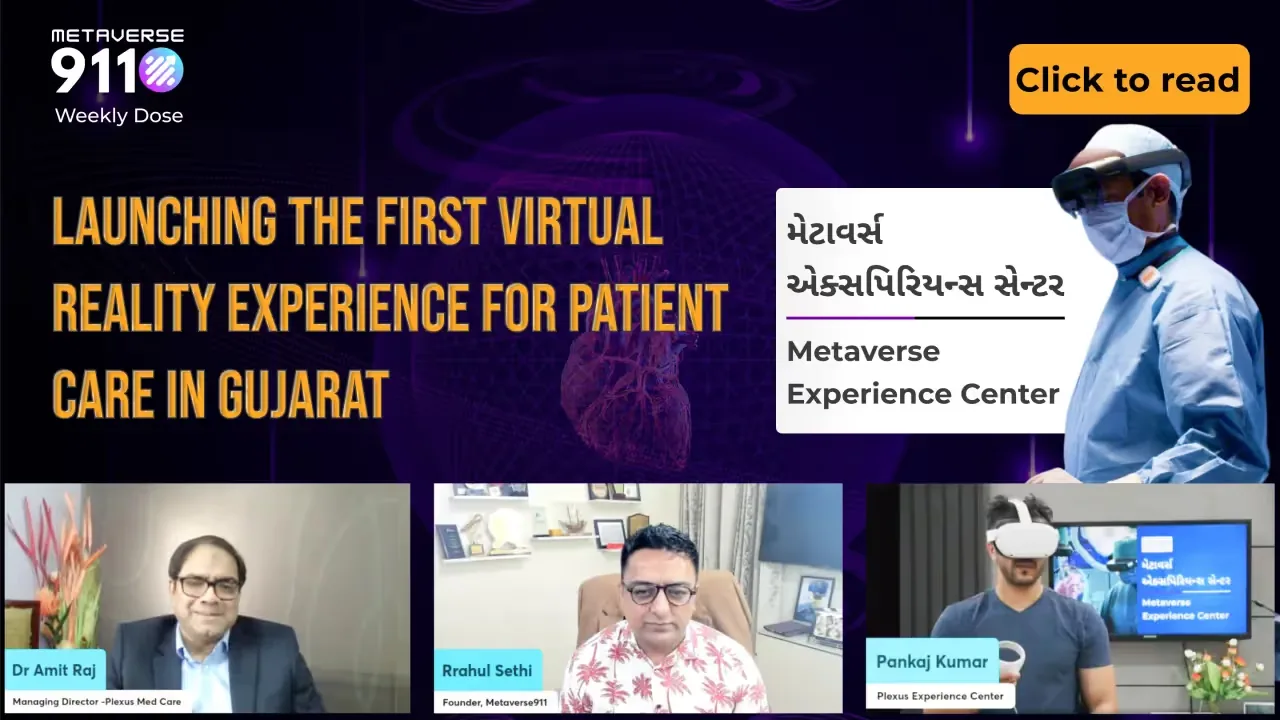
Launching Gujarat's first virtual reality experience for patient care
We launched a VR patient care experience at the Plexus Metaverse Experience Center with Dr Amit Raj: virtual hospital tours, medical training and calm VR.
Read the post Blog · Healthcare & pharma
Immersive technology in a hospital: the Plexus Metaverse Experience Center
Why we are building a Metaverse Experience Center with Plexus Med Care: AR remote consultation, VR medical training and VR patient care, with global examples.
Read the post Blog · Healthcare & pharma
Pharma XR Day Chapter 2: how pharma leaders are using VR and AR
At Pharma XR Day Chapter 2, 20+ leaders from firms such as Roche, Alkem and Medtronic tried 18+ XR solutions for pharma training, sales and science content.
Read the post