

Summary
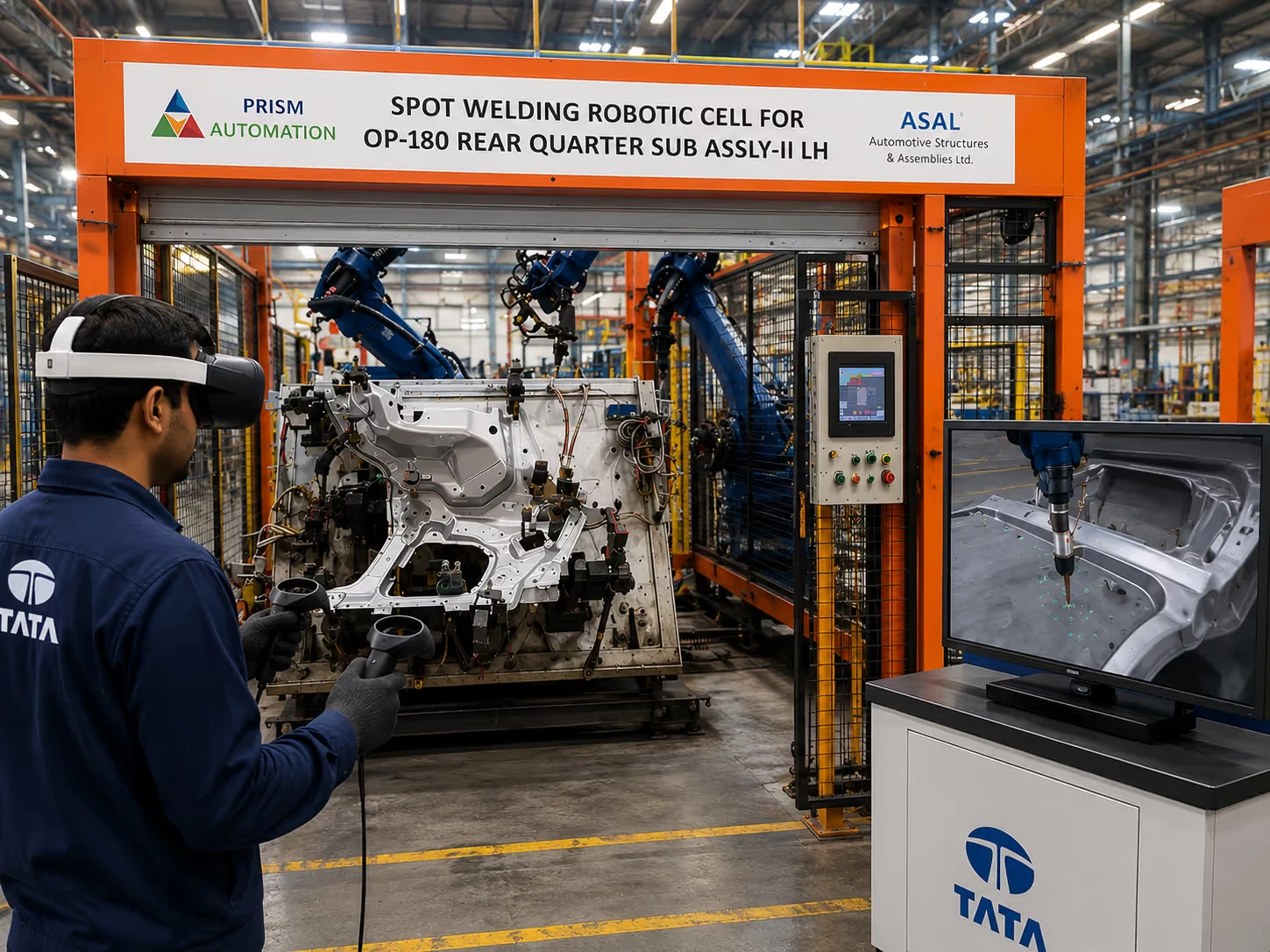
We designed and deployed a VR training programme for new sheet metal stamping and welding operators at a Tata Group company in India. It recreates the shop floor 1:1 on Meta Quest 3 standalone headsets and is now used across six plants. After roll-out, customer PPM fell from 329 to 100, internal PPM from 2,000 to 500, and the cost of poor quality halved.
The challenge
Onboarding a stamping or welding operator is high-stakes work. The machines are heavy, cycle times are tight, and one mishandled press or weld can mean rework, missed JPH targets or an injury. Early operator training relied on the classroom, and the leadership team saw four problems with it:
- No experience on the actual machines: trainees reached the shop floor with theory but no muscle memory.
- A classroom cannot convey real risk: the seriousness of an interlock failure does not come across in a slide deck.
- High safety risk early on: most machine mishandling and first-aid cases happened in an operator's first weeks.
- Inconsistent quality: without standard practice, defect rates and rework went up.
The brief was a VR programme that mirrors the shop floor, without the risk, the downtime or the inconsistency.
What we built
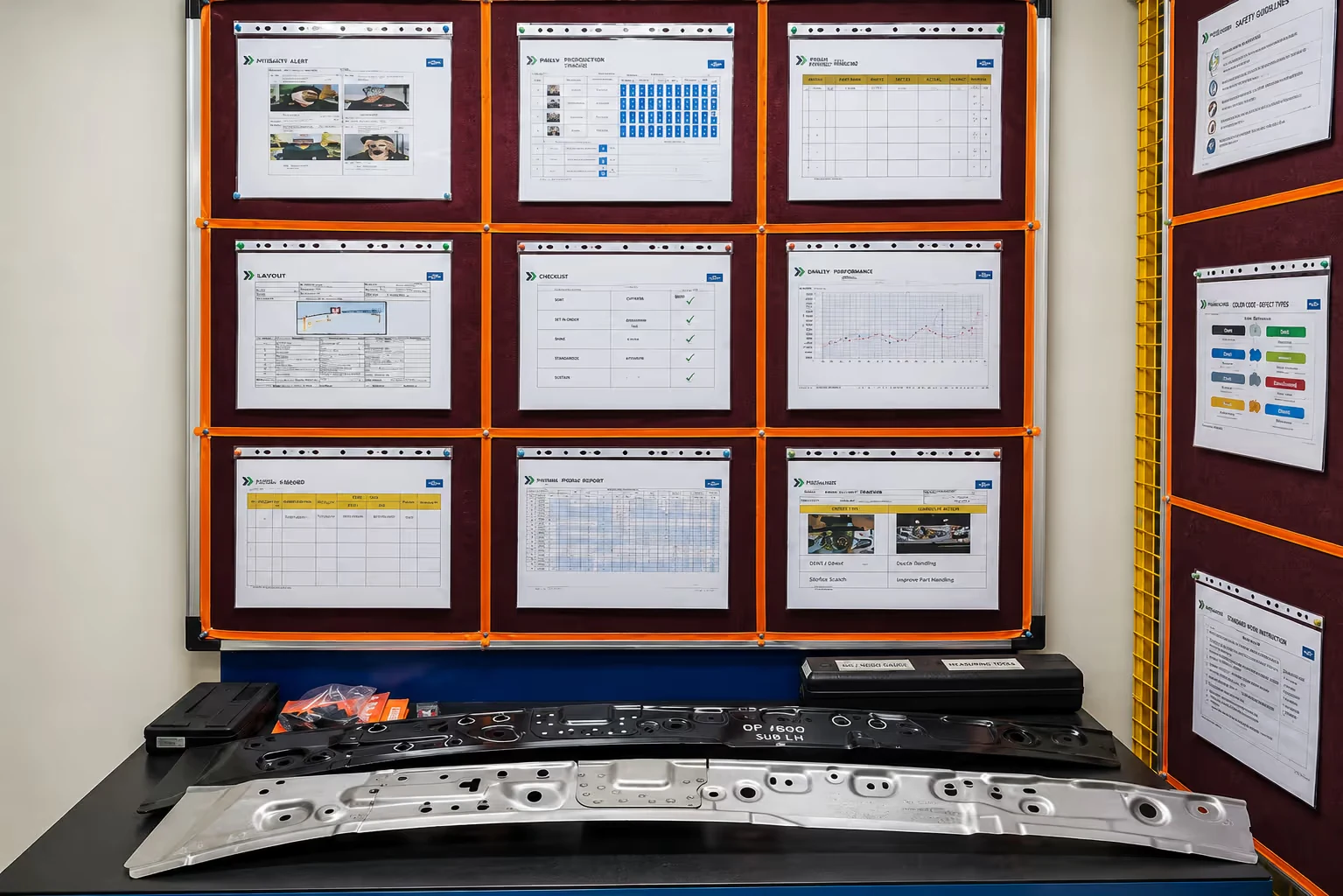
The programme copies the shop floor 1:1: the same machines, the same fixtures and the same SOPs. It is an interactive VR environment, not a 360° video.
How we built it
- Alignment: meetings with leadership, training owners and safety representatives to agree expectations and scope.
- Plant floor study: live observation of stamping cycles, operator shadowing, reference photos and SOP validation.
- Design: final SOPs, VR architecture, module flow, interaction logic and the assessment framework.
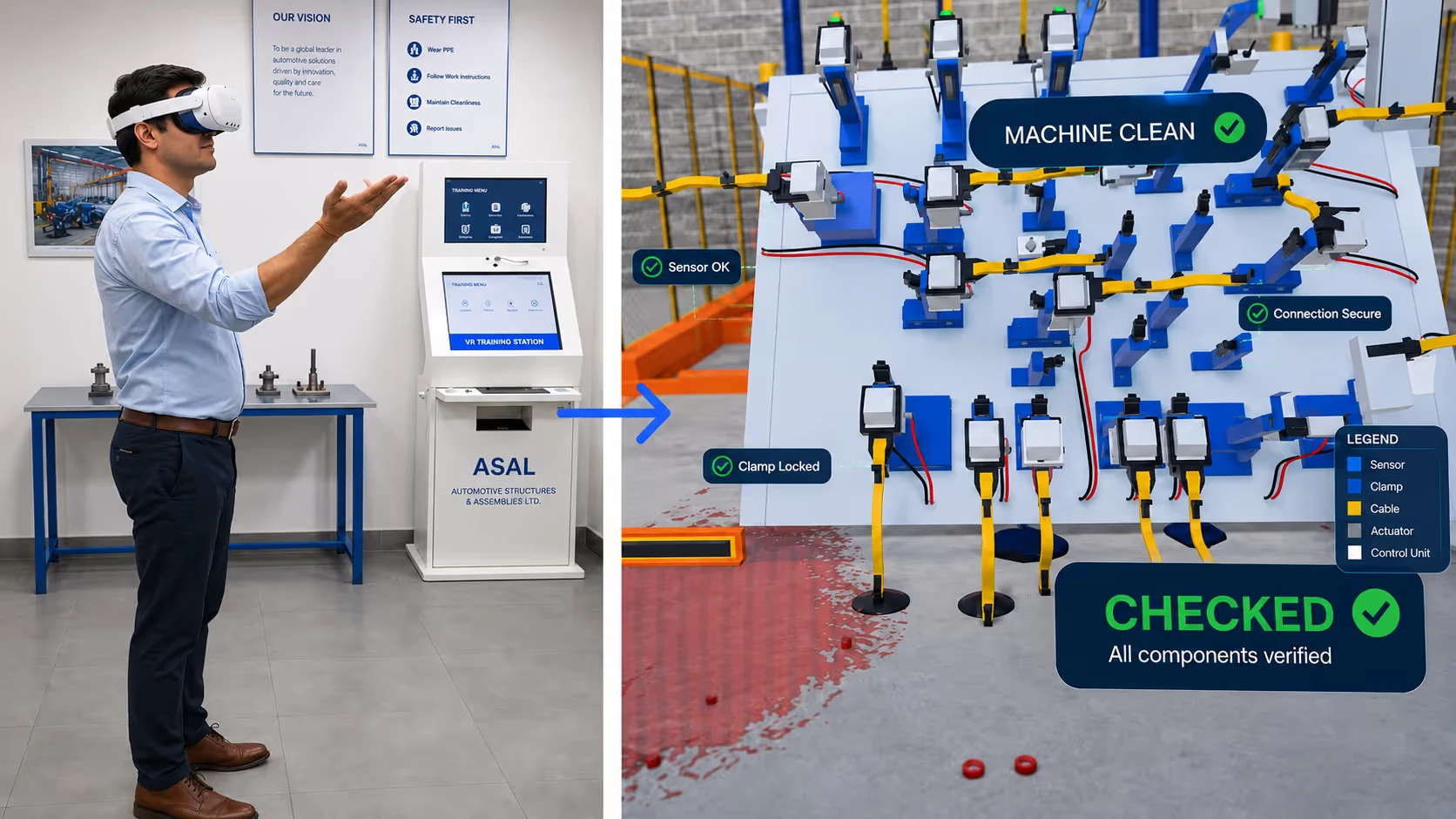
- 3D modelling: stamping machines, fixtures, tools and the shop-floor environment, modelled from scratch for accurate recognition.
- Motion and physics: realistic movement for every machine operation, including 54-step sequences and material movement.
- Integration: environment, controller interactions and the assessment system with its database, shipped to Meta Quest 3.
What operators learn
The programme has six learning layers:
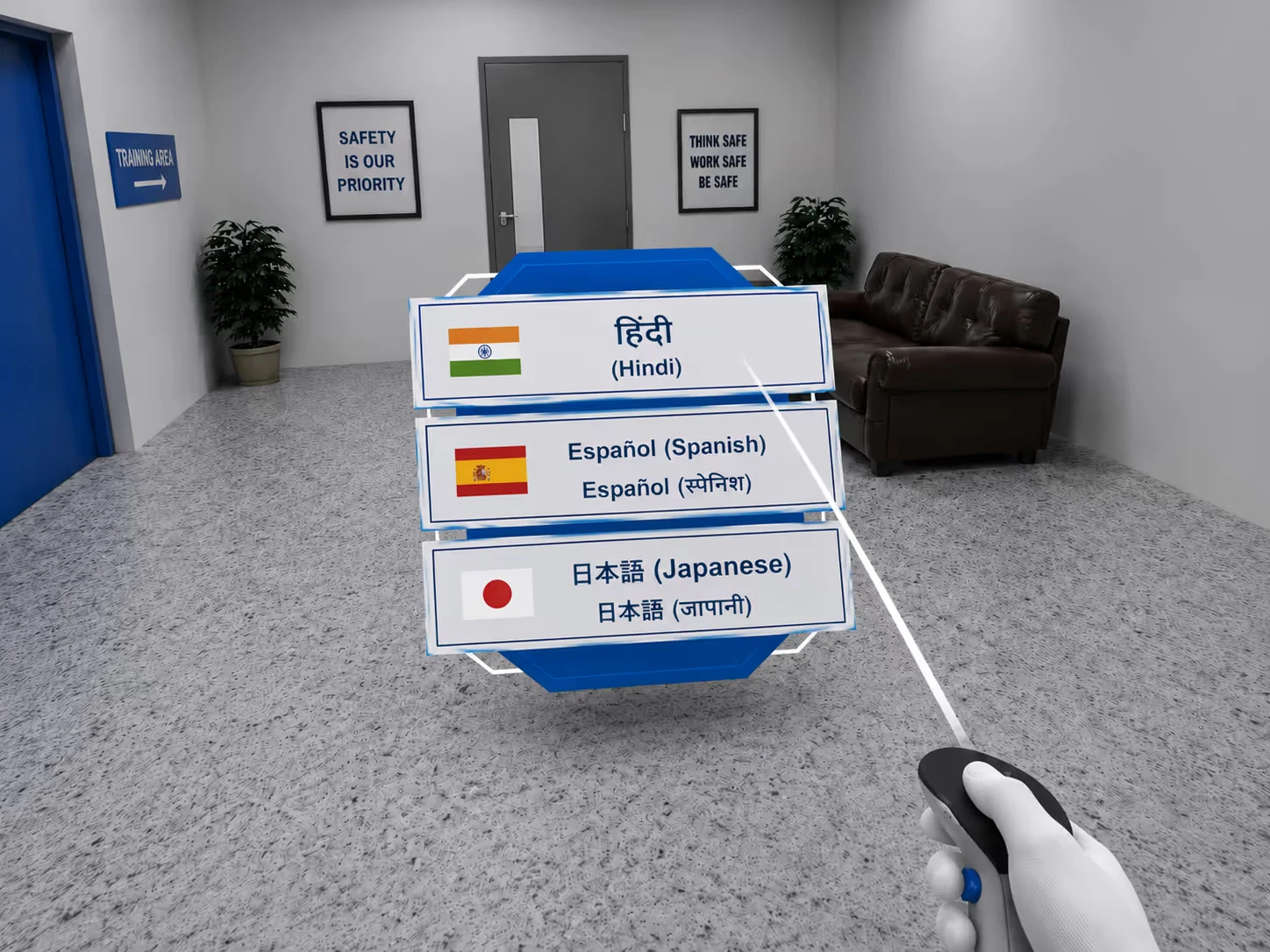
- Language: Hindi, English and Marathi, with voiceover, text and an icon-led interface.
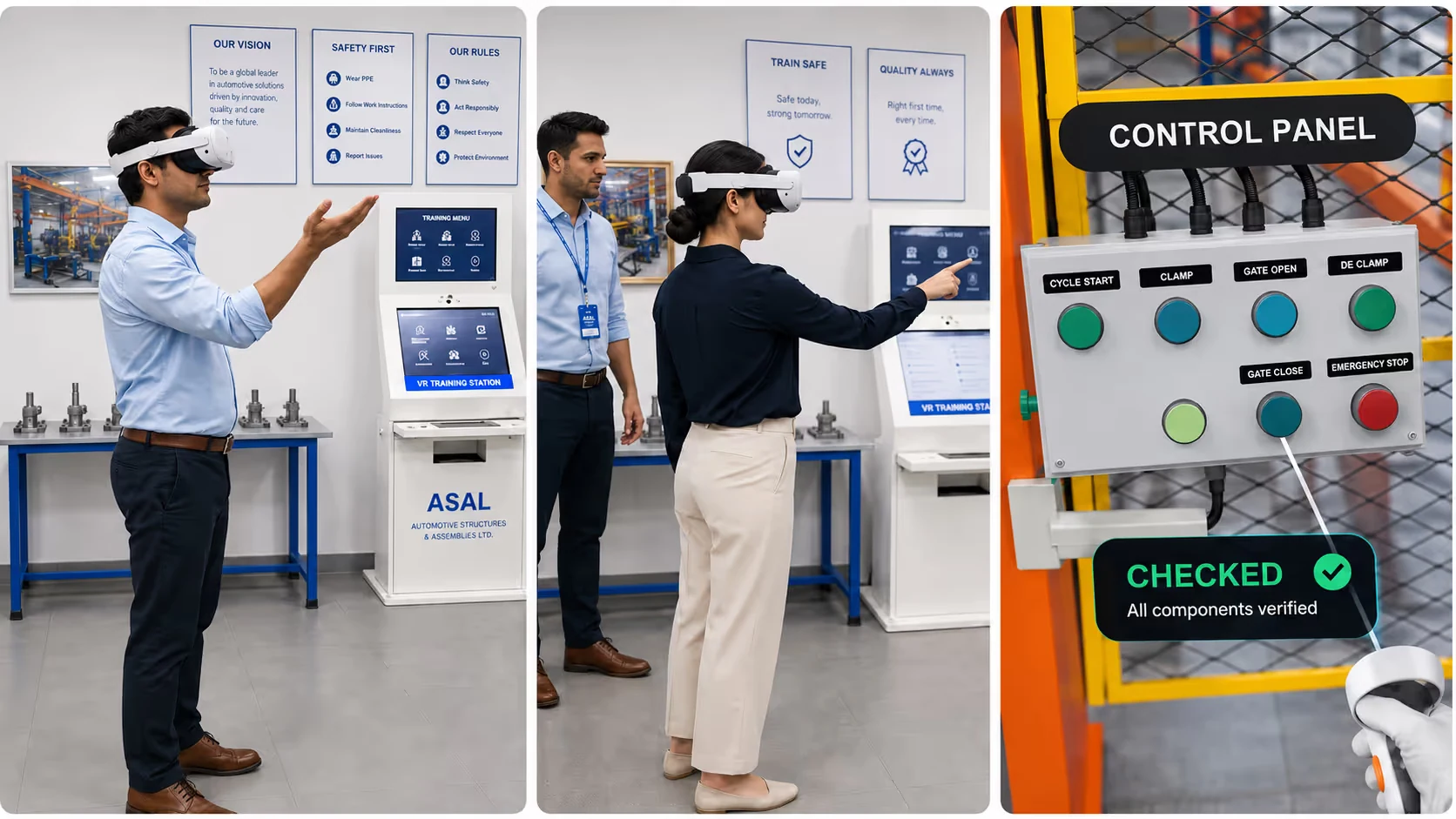
- PPE: choosing and wearing a helmet, goggles and gloves correctly. Missing items are flagged and the trainee cannot continue without them.
- Shop-floor safety: restricted zones, safe walkways, safety signs, and safe versus unsafe behaviour, with instant feedback on violations.
- Machine familiarisation: control locations and functions, interlocks and sensors, emergency switches and hazard zones.
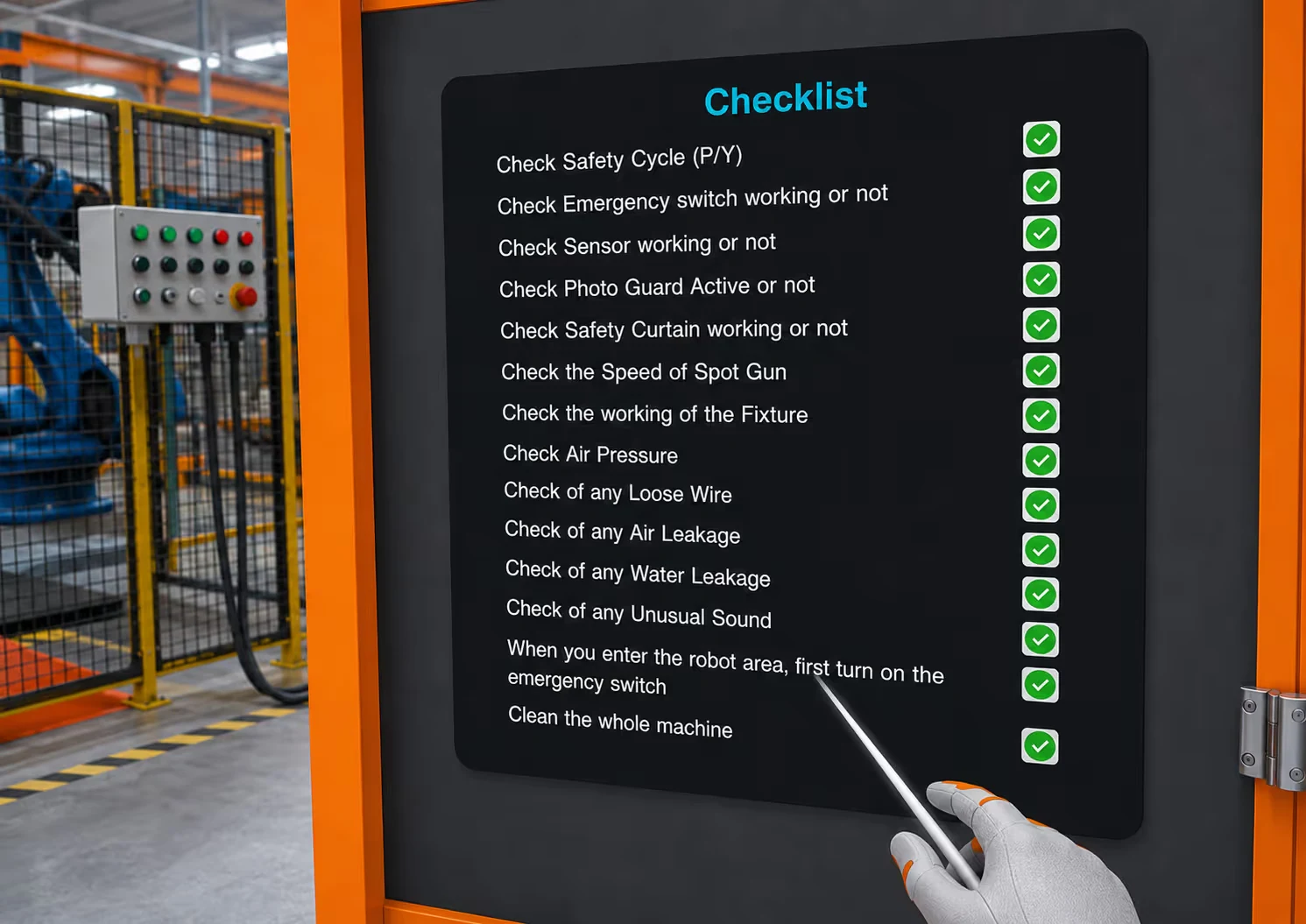
- Guided practice: a step-by-step workflow from pre-operation to operation to inspection, with active interactions and repetition without risk.
- Assessment: an unguided mode scored on sequence, errors and time. Passing earns a VR completion certificate, which is required before going onto the shop floor.
Hardware and deployment
The programme runs on Meta Quest 3 standalone headsets (2,064 × 2,208 per-eye resolution, pancake lenses, 120 Hz, Snapdragon XR2 Gen 2). Standalone hardware was essential for rolling out across plants. A web-based admin dashboard covers workforce tracking, batch analytics, scorecards and user management.
Deployment is fully offline, on a local server at each plant, usually a mini-PC or industrial edge server in the training room. No internet is needed after set-up, data stays on the device or plant server, and access sits behind the plant's own firewall. The same programme can also be hosted on a company's private cloud over VPN, or on AWS, Azure or GCP.
How it works on the shop floor
- A trainee can mishandle a stamping press many times in VR without consequence, and the muscle memory carries over to the real machine.
- Every operator at every plant sees the same SOP, machine layout and hazard cues, with no variation between instructors.
- Time, error count and sequence accuracy are scored automatically, so supervisors have data instead of guesswork.
- Trainees do not need real machine time during onboarding, so the press keeps running while they learn.
Results
- Customer PPM down from 329 to 100
- Internal PPM down from 2,000 to 500
- Cost of poor quality (COPQ) halved
- One curriculum running across six plants with no rebuild cost, for 9,000 to 13,500 trained operator-sessions a year
Lower PPM and COPQ also mean better supplier ratings and lower warranty liability.
About the solution
Blue-collar VR training
Step-by-step VR modules for machine operation, assembly, maintenance and quality checks. Trainees practise as many times as they need, in the language your team speaks, without stopping a production line.
- Built from your SOPs, work instructions and CAD data
- Voice-guided step by step
- AI trainer avatars that answer questions
- Works on standalone headsets, no PC needed
More about blue-collar vr training
Employee onboarding
Give every new joiner the same first week: a VR tour of the plant, the company story, safety basics and their role, delivered the same way in every location. HR gets completion data for every person.
- VR plant tour and company introduction
- Role-based training paths
- Completion tracking and reports
Frequently asked questions
What VR training did Metaverse911 build for a Tata Group company's sheet metal operators?
Metaverse911 designed and deployed a VR training programme for new sheet metal stamping and welding operators at a Tata Group company in India. It recreates the shop floor one to one, with the same machines, fixtures and SOPs, on Meta Quest 3 standalone headsets. It is an interactive VR environment, not a 360 degree video, and runs across six plants.
What results did VR operator training deliver at the Tata Group company?
After the VR training programme was rolled out at the Tata Group company, customer PPM fell from 329 to 100, internal PPM fell from 2,000 to 500, and the cost of poor quality halved. One curriculum runs across six plants with no rebuild cost, for 9,000 to 13,500 trained operator-sessions a year.
Does the Tata Group VR training programme need an internet connection?
The Tata Group VR training programme runs fully offline, on a local server at each plant, usually a mini-PC or industrial edge server in the training room. No internet is needed after set-up, data stays on the device or plant server, and access sits behind the plant's own firewall. It can also be hosted on a private cloud, AWS, Azure or GCP.
What do operators learn in the Tata Group VR training programme?
The Tata Group VR training programme has six learning layers: a choice of Hindi, English or Marathi; correct PPE use; shop-floor safety; machine familiarisation, including interlocks and emergency switches; guided step-by-step practice; and an unguided assessment scored on sequence, errors and time. Passing earns a VR completion certificate, required before going onto the shop floor.
How do supervisors track trainees in the Tata Group VR training programme?
Supervisors track trainees through a web-based admin dashboard covering workforce tracking, batch analytics, scorecards and user management. In the VR programme, time, error count and sequence accuracy are scored automatically, so supervisors have data instead of guesswork, and every operator at every plant sees the same SOP, machine layout and hazard cues.
Other client work

Spark Minda
Spark Minda turns its nine Smart Dojo principles into hands-on AR and VR zones
Read the case study
TAFE
TAFE builds India's first AR-powered experience centre for tractors
Read the case study
Tata Electronics
An offline 3D touchscreen platform for the Tata Electronics experience centre
Read the case study