

Summary
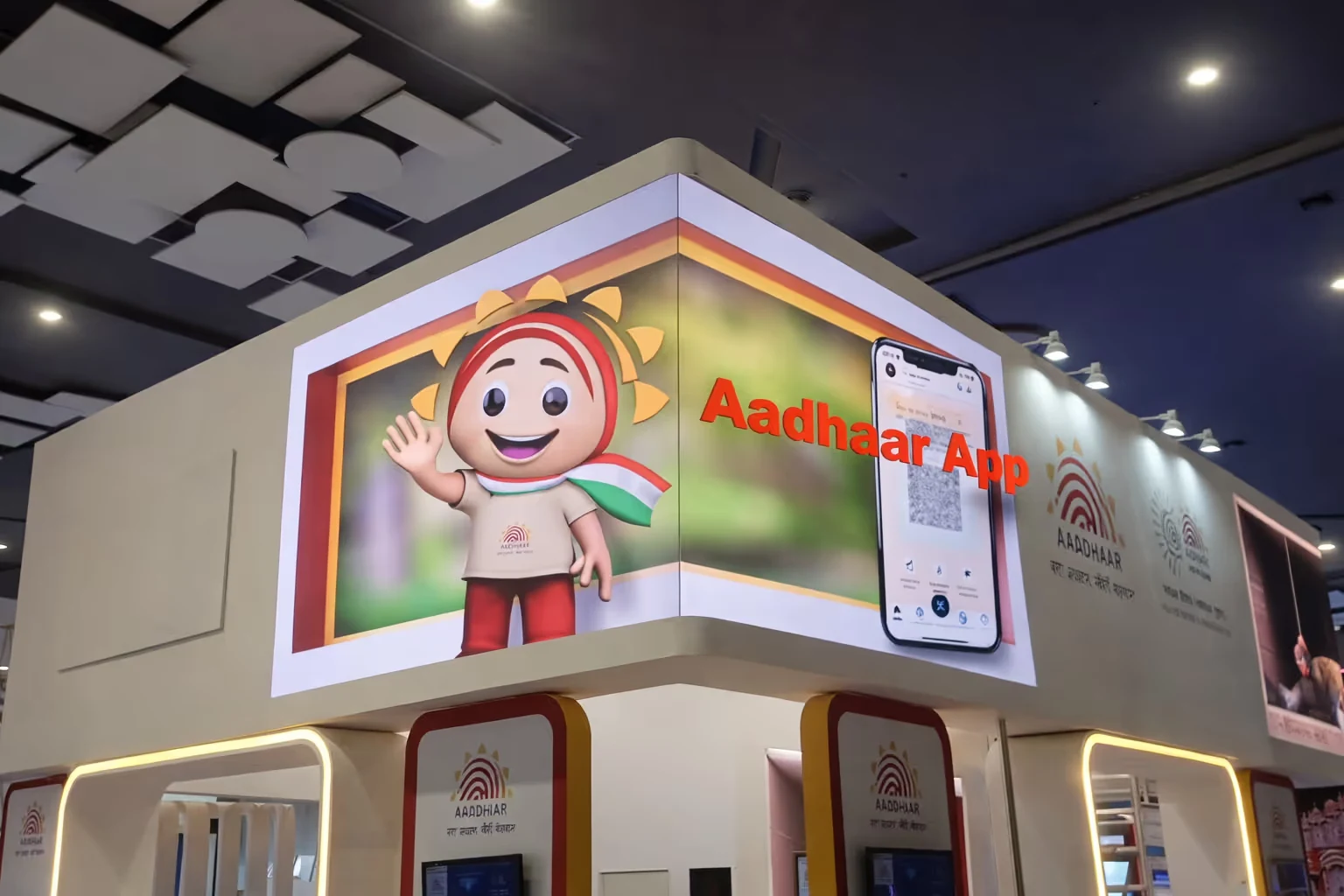
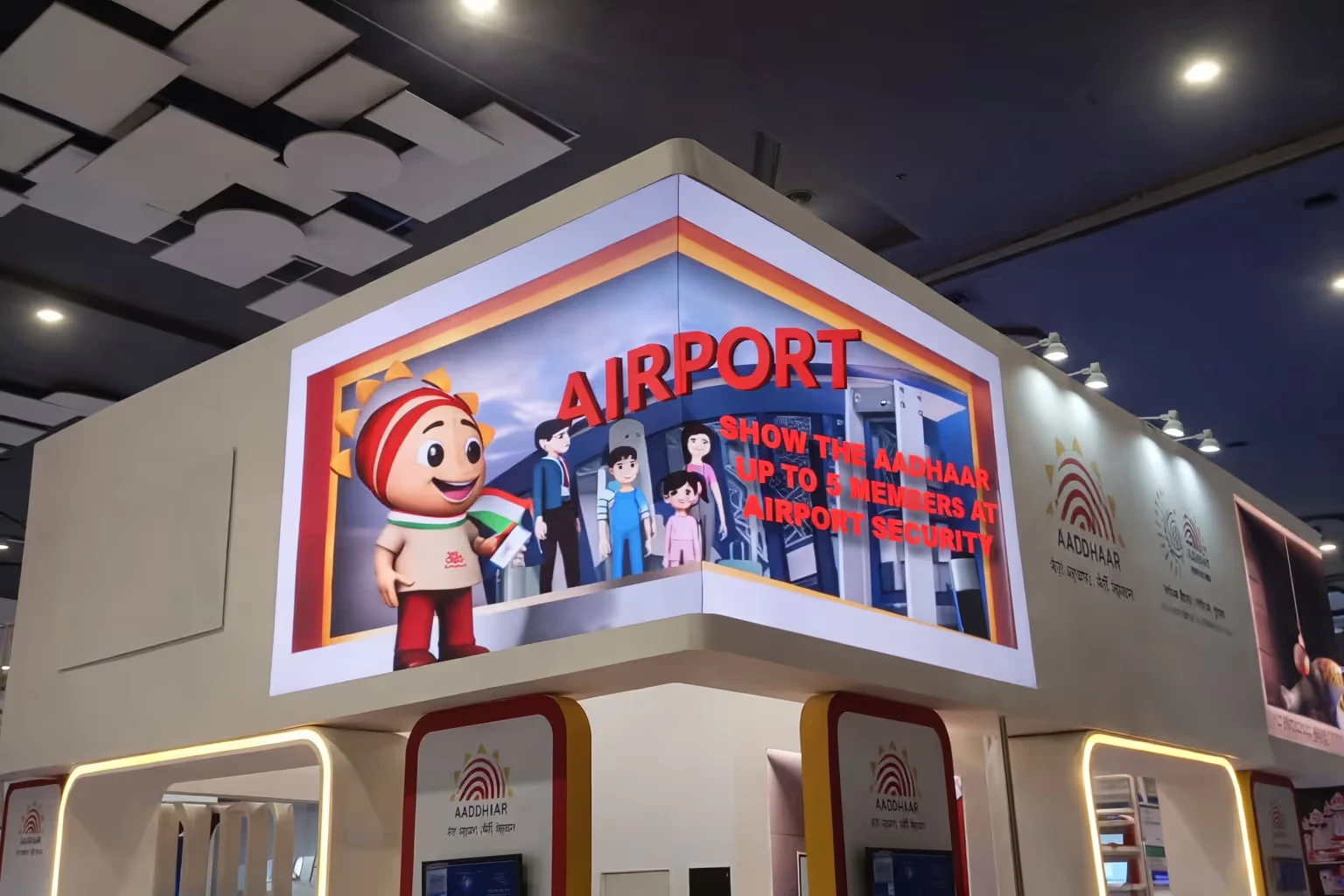
For the Unique Identification Authority of India (UIDAI), we designed, produced and ran an L-shape anamorphic LED installation on the Aadhaar booth fascia at India AI Impact Summit 2026. The summit ran from 16 to 21 February at Bharat Mandapam, New Delhi.
The 3D content was built around the features of the Aadhaar App. The display drew visitors from more than 20 metres away and played without a single technical issue for the whole event.
The brief: make a digital identity story stand out at a crowded summit
About UIDAI and Aadhaar
UIDAI is the statutory authority set up under the Aadhaar Act, 2016. It enrols residents and issues Aadhaar, India’s biometric-based digital identity. With over 1.42 billion people enrolled, Aadhaar is the world’s largest biometric digital identity programme.
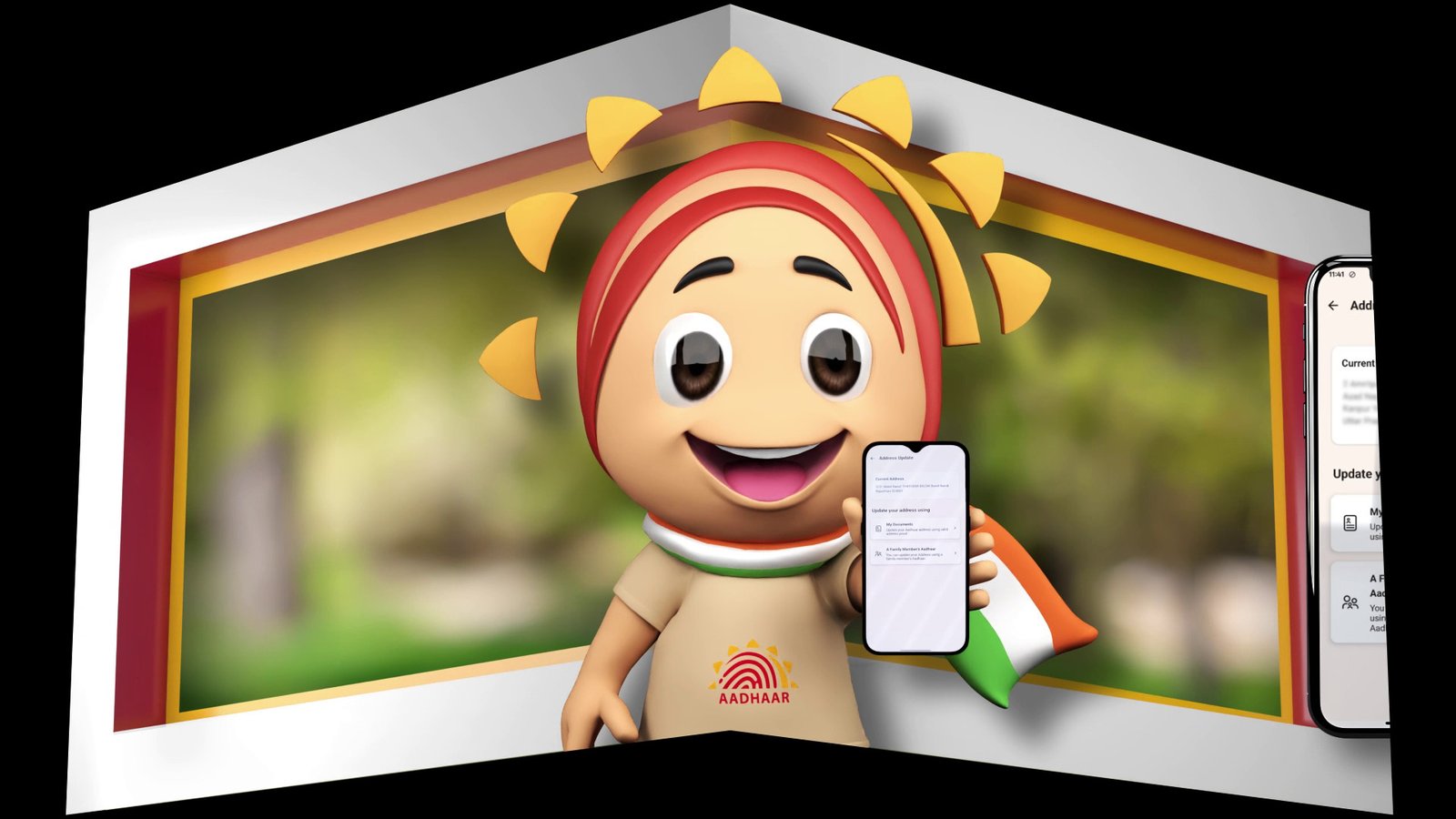
Aadhaar sits behind direct benefit transfers, banking, healthcare, income tax and mobile authentication. The Aadhaar App puts it on citizens’ phones, with paperless KYC, face authentication, QR-based identity sharing and secure offline verification.
About the summit
India AI Impact Summit 2026 was the first major global AI summit held in the Global South. It was inaugurated by Prime Minister Narendra Modi and attended by delegations from over 100 countries, with about six lakh people in person and nearly nine lakh watching online.
Hundreds of exhibitors competed for the same visitors. UIDAI wanted to show that Aadhaar is innovation as well as infrastructure, to an audience of policymakers, enterprise leaders and global delegations. Standard screens would not have stood out on that floor.
What we built
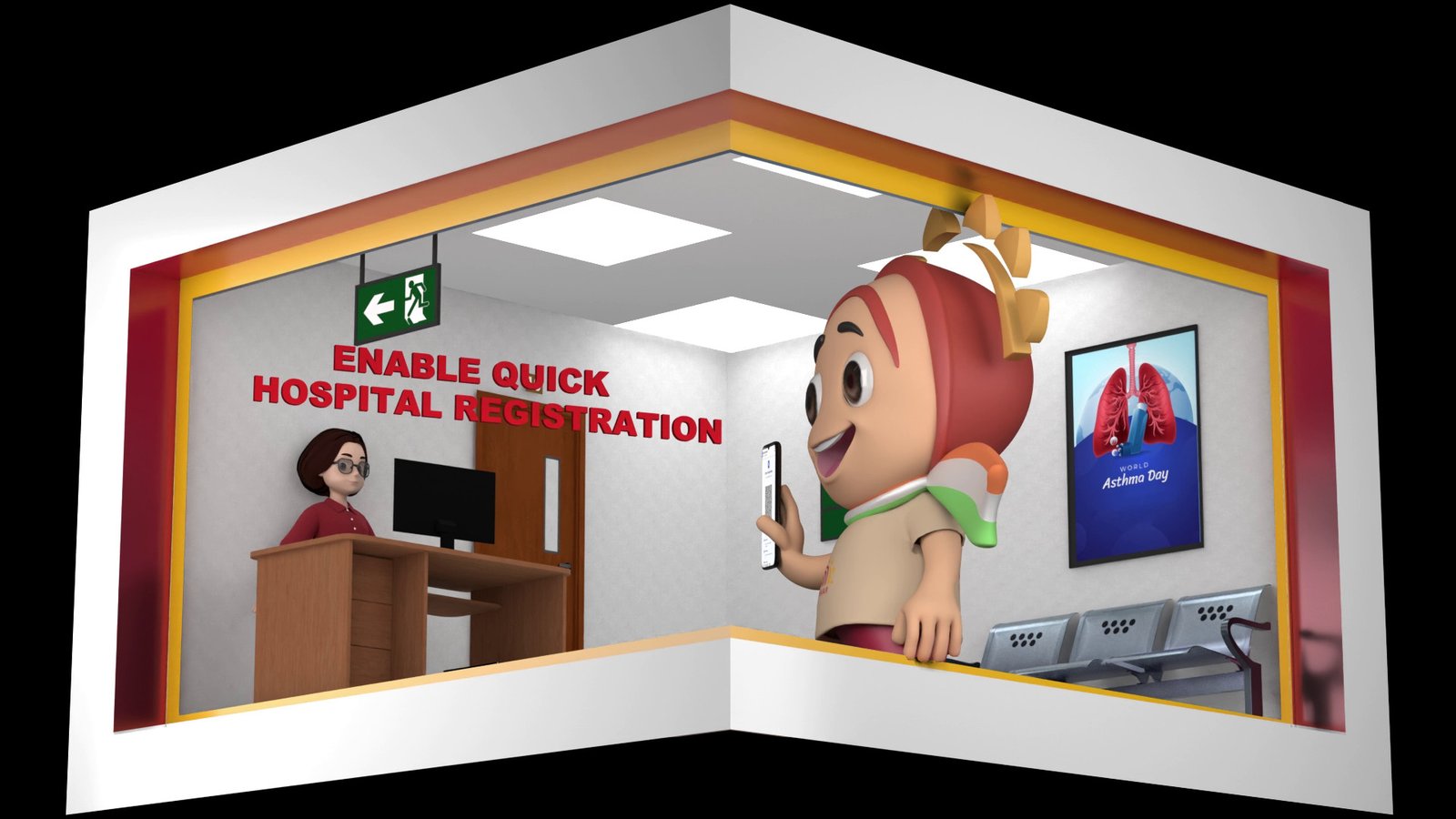
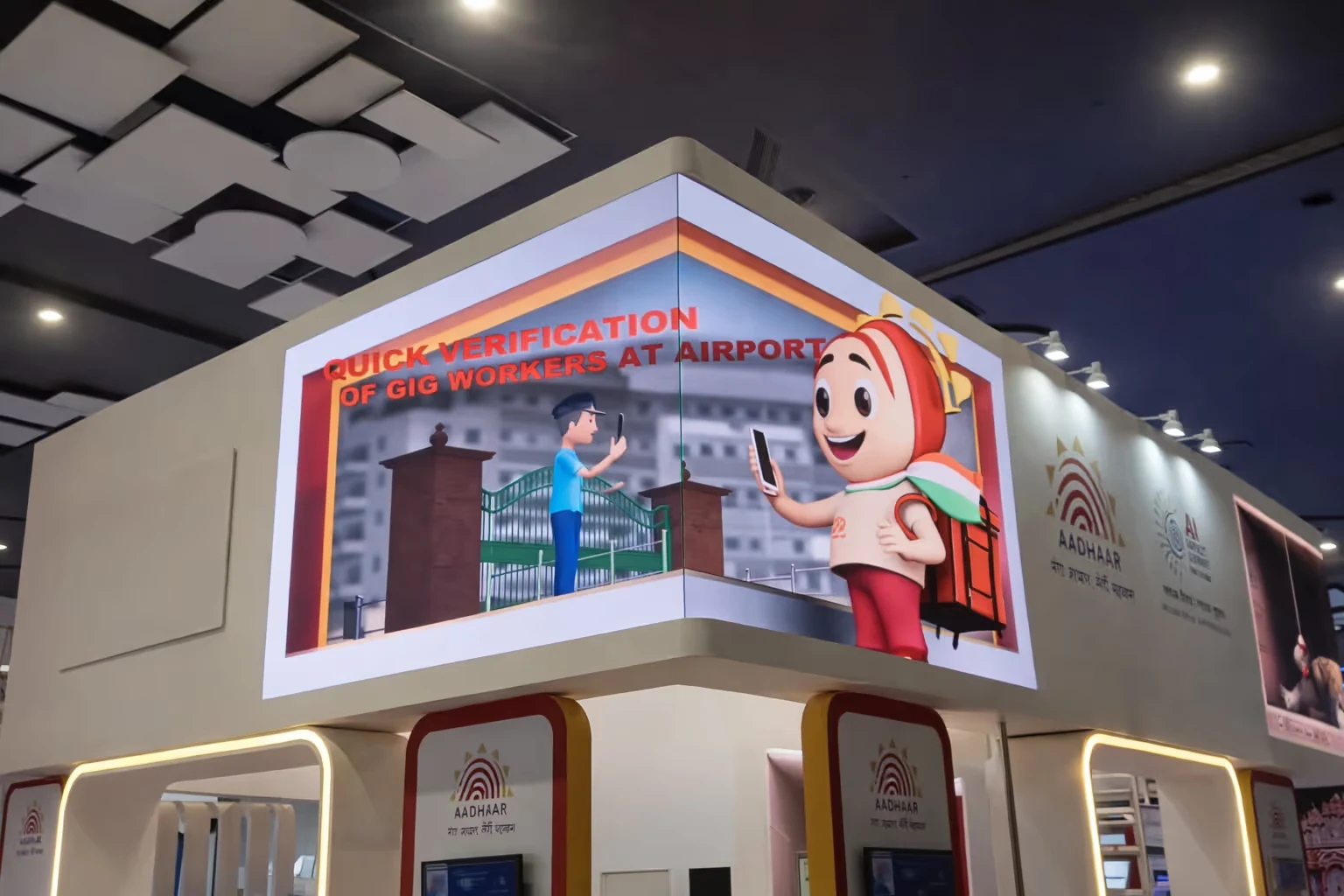
Two LED panels meet at a 90-degree corner on the booth fascia. We mapped the content to that corner so it produces a 3D forced-perspective effect: elements appear to float and extend out of the screen into the hall. The shared edge of the two screens acts as a vanishing point, which makes the effect much stronger than on a flat wall.
Content: the Aadhaar App, feature by feature
The loop worked as a 3D product reveal. Each Aadhaar App feature had its own moment, with interface elements and data flows appearing in the space between the wall and the viewer.
The content also showed the features in real use: rural banking, healthcare access, travel identity and social benefit delivery. Abstract ideas such as KYC, biometric authentication and offline verification became something visitors could see.
Why an anamorphic L-shape
Visitors expect flat screens at an exhibition. An anamorphic corner makes people stop and look before they know what the content is about. In a crowded hall, most displays get noticed at 2–5 metres; an anamorphic LED display can pull attention from 15–20 metres away, before visitors reach the booth.
How we made it
Every L-shape installation is built from scratch for its space. We handled each stage in-house:
- Site and brief analysis to choose the LED format, panel size, corner angle and position on the Bharat Mandapam floor plan.
- 3D production: concept, storyboard, modelling, rigging and animation, matched to the Aadhaar App’s features and visual identity.
- Anamorphic warping, so every frame lines up with the corner geometry and the viewer’s sweet spot, calibrated to the real viewing distances and angles on the summit floor.
- Post-production, LED content formatting and quality checks against the exact specification of the LED hardware at the venue.
How it worked on the day
Our crew installed the LED panels, aligned the corner, set up playback and calibrated the sweet spot before the summit floor opened. A Metaverse911 operations team then stayed on site throughout, monitoring the display and giving immediate technical support. There were no handoffs to third parties.
Because the display sat on the fascia, it could be seen across the hall and still worked up close for visitors at the booth.
Results
- The installation became one of the most discussed booth experiences on the summit floor.
- Visitors stopped mid-stride to work out what they were seeing, which kept them at the booth for longer.
- The display drew foot traffic from more than 20 metres away.
- It gave Aadhaar a credible presence for international delegations and government stakeholders.
- Playback ran without a technical issue for the whole summit.
- It is now our reference project for anamorphic LED in the government sector.
Frequently asked questions
What is an L-shape anamorphic LED display?
Two LED screens meet at a 90-degree corner and play content that is warped to match that corner. From the right spot, the content looks three-dimensional and seems to come out of the screen.
Who made the content for the Aadhaar display?
We did. Our creative and technical teams handled the 3D modelling, animation and anamorphic warping in-house, and our crew installed and ran the display at the summit.
Can the same approach work for other government or enterprise booths?
Yes. Each installation is designed for its own space and content. Talk to our team about your next event.
Where and when was the Aadhaar anamorphic LED display shown?
The Aadhaar anamorphic LED display was shown on the UIDAI booth at India AI Impact Summit 2026, held from 16 to 21 February at Bharat Mandapam, New Delhi. Metaverse911 designed, produced and ran the L-shape installation on the booth fascia, and it played without a single technical issue for the whole summit.
What results did the Aadhaar anamorphic display achieve at India AI Impact Summit 2026?
The Aadhaar L-shape anamorphic display drew visitors from more than 20 metres away and became one of the most discussed booth experiences on the summit floor. Visitors stopped to work out what they were seeing, which kept them at the booth longer. It gave Aadhaar a credible presence for international delegations and ran without a technical issue.
Other client work
Edgetech
A 3D printed AHU model, AR, touch kiosk and 3D film for Edgetech at ACREX 2026
Read the case study
Avantec
Flat facia anamorphic content for Avantec Aircon at ACREX 2026
Read the case study
C-DOT
An L-shaped anamorphic LED display for C-DOT at India Mobile Congress 2025
Read the case study