

Rrahul Sethi, our founder, has run a recruitment company for more than 10 years. Onboarding and early engagement were problems he saw HR teams face again and again. This article sets out why traditional onboarding struggles and how a virtual, interactive approach can help.
Why traditional onboarding loses new hires
HR teams carry a lot of responsibility in a new hire's first weeks, from the initial paperwork to the training modules. The aim is to set each person up to succeed.
In practice, traditional onboarding is often tedious and slow. New hires sit through long training sessions and fill in forms for hours. Their enthusiasm drops, and they come away with little real understanding of the company's culture.
The biggest problem is low engagement. Disengaged new hires are less likely to stay, and they take longer to become productive.
The idea: onboarding in a shared virtual space
Virtual onboarding introduces new hires to the company's culture, values and processes inside a 3D environment. New joiners can meet colleagues as avatars, explore a virtual version of the office and learn about the company's mission through activities rather than slides.
Example: Kotak Mahindra Bank's Learning-a-fair
Kotak Mahindra Bank engaged more than 35,000 employees through "Learning-a-fair", a learning experience built in the metaverse. The experience won a Brandon Hall award and was designed to encourage collaboration, engagement and new ideas among employees.
Kotak used GMetriXR to deploy it. GMetri's no-code toolkit lets teams create, manage and track their own virtual experiences. Its templates shorten implementation, so L&D and HR teams can launch an experience with less support from outside agencies.
How to set up virtual onboarding: seven steps
You cannot simply launch a virtual onboarding programme and expect it to run smoothly. These steps help it work from the first cohort.
- Try it yourself first. Spend time in virtual worlds: play games and attend events. You will understand what your new hires will experience.
- Understand the concept. Research what virtual environments can and cannot do for onboarding, and keep up with developments.
- Set clear objectives. Decide whether the priority is building a sense of community, teaching specific skills or creating an immersive learning experience. Clear goals shape the design.
- Choose a platform. Compare the features of different platforms and pick the one that fits your company's needs.
- Build your presence. Create avatars for team members, a virtual office or workspace, and a branded company space.
- Plan how people will learn the platform. Choose between live virtual training sessions, a written user guide or self-guided exploration, and give everyone the resources to feel comfortable.
- Make it interactive, then ask for feedback. Add team-building activities, icebreakers and games to help new hires remember what they learn and feel connected. Ask what works and what does not, and adjust the programme.
Next step
If you are planning onboarding for new joiners across several plants or offices, talk to our team about interactive and VR-based onboarding that gives every joiner the same first week.
First published on the Metaverse911 blog.
Frequently asked questions
Why does traditional employee onboarding lose new hires?
Traditional onboarding often loses new hires because it is tedious and slow. New joiners sit through long training sessions and fill in forms for hours, so their enthusiasm drops and they gain little real understanding of the company's culture. The biggest problem is low engagement, because disengaged new hires are less likely to stay and take longer to become productive.
What is virtual onboarding in a 3D environment?
Virtual onboarding introduces new hires to a company's culture, values and processes inside a shared 3D environment. New joiners can meet colleagues as avatars, explore a virtual version of the office and learn about the company's mission through activities rather than slides. The aim is to keep new hires engaged and connected during their first weeks.
How did Kotak Mahindra Bank use the metaverse for employee learning?
Kotak Mahindra Bank engaged more than 35,000 employees through "Learning-a-fair", a learning experience built in the metaverse and designed to encourage collaboration, engagement and new ideas. The experience won a Brandon Hall award. Kotak deployed it using GMetriXR, whose no-code toolkit lets teams create, manage and track their own virtual experiences.
What are the seven steps to set up virtual onboarding for new hires?
The seven steps for virtual onboarding are: try virtual worlds yourself first, understand what virtual environments can and cannot do, set clear objectives, choose a platform, build your presence with avatars and a branded virtual office, plan how people will learn the platform, and make the programme interactive with games and icebreakers before asking new hires for feedback.
Can Metaverse911 help with onboarding new joiners across several plants or offices?
Metaverse911 offers interactive and VR-based onboarding for companies planning onboarding for new joiners across several plants or offices. The aim is to give every joiner the same first week, wherever they start. HR and L&D teams can talk to the Metaverse911 team to discuss how this approach would fit their own onboarding programme.
More from the blog
Blog · Training & L&DVirtual dojo rooms: better manufacturing training with immersive technology
How virtual dojo rooms give manufacturing trainees realistic, risk-free practice without floor space limits, and where the return on investment comes from.
Read the post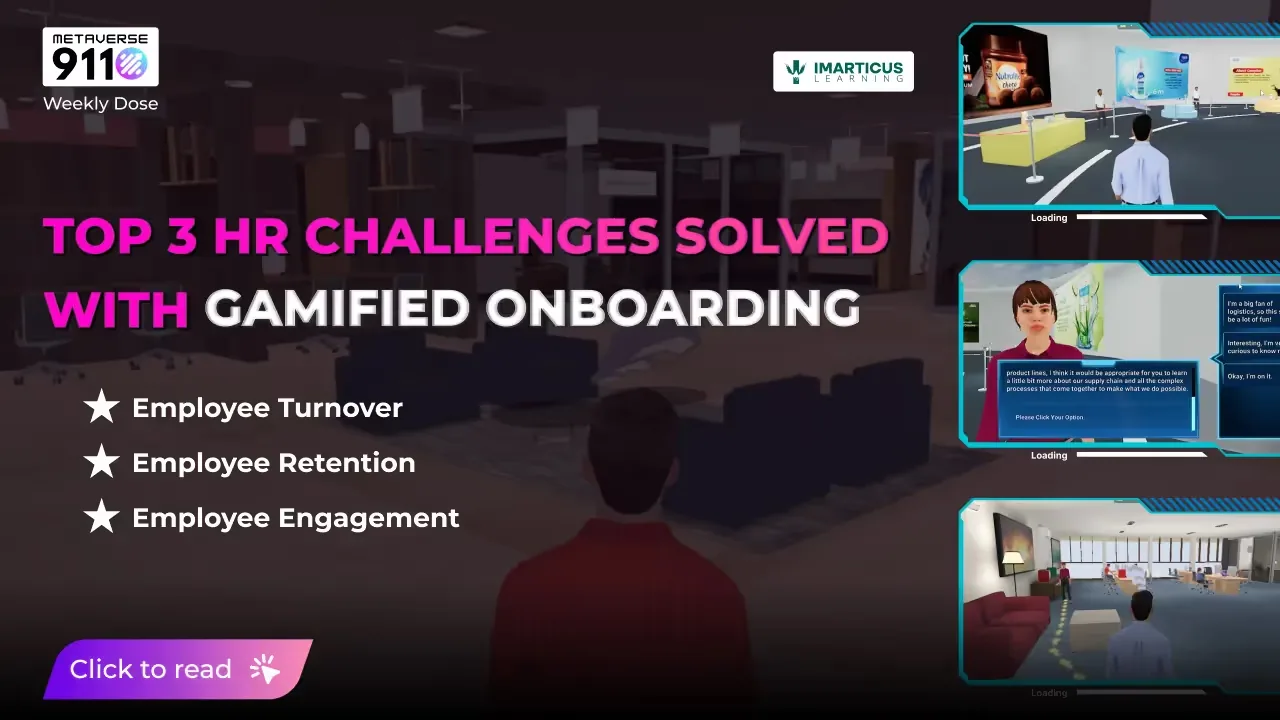 Blog · Training & L&D
Using gamified onboarding to improve retention and engagement
How gamified onboarding helps HR leaders predict turnover, standardise remote induction and lift engagement, with Zydus Wellness as a worked example.
Read the postBlog · Training & L&DHow HR leaders can use virtual worlds for hiring, engagement and training
How HR leaders can use virtual worlds for recruitment, engagement, retention, remote collaboration and training, with survey data and company examples.
Read the post